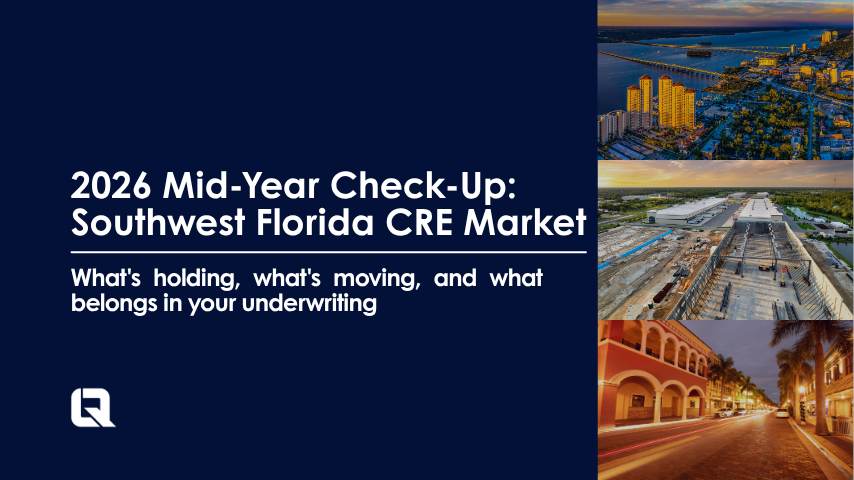
Halfway through the year, Southwest Florida looks like a market with strong fundamentals and very little new product coming out of the ground. Demand is there. Vacancy is tight. Construction is not keeping up.
Here is where each sector stands going into the second half, drawing on data and transaction detail presented at the recent CCIM Southwest Florida Market Outlook.
Office: healthy market, no new supply
Southwest Florida has one of the healthiest office markets in the country. Vacancy sits in equilibrium across every submarket, and true vacancy drops to somewhere between 2 and 5 percent once functionally obsolete and undesirable space is backed out.
That should be triggering spec development. It isn’t. New construction in Lee County needs roughly $35 per square foot net to pencil, and the market is paying $10 to $15 below that. Hard costs alone run $345 to $400 per square foot.
What it means: quality second-generation product is undervalued and positioned for above-average rent growth as supply stays tight. Below replacement cost is not a strategy on its own. Leases in place, encumbrances, and deferred maintenance decide the outcome.
Retail: essential needs and outparcel velocity
Retail is the sector moving at full speed. Absorption is growing, construction has balanced out after a heavy supply year, and rent growth continues.
Essential needs leads: food, gas, convenience, and daily-use categories.
Two things belong in every retail underwrite right now. Impact fees have become a material line item, with a Collier County calculation for a standalone quick-service restaurant landing near $745,000 against $200,000 to $300,000 historically. And outparcel velocity is exceptional in high-traffic corridors.
What it means: developers are getting ahead of rooftops, moving into corridors where lots are still on paper. Burnt Store Road, the 82 corridor into Lehigh Acres, and the Ave Maria and Big Cypress area are where activity is concentrating.
Industrial: a full year of volume in six months
The Naples market has already surpassed all of last year at the halfway mark. There’s been $124 million in transaction volume in 2026 so far, compared against $108 million for all of 2025. Pricing has stabilized near $198 per square foot, and lease rates have settled around $19 net.
Vacancy sits around 4.5 percent, above the historical 1 to 2 percent. Several large blocks are coming available, and filling them requires pricing that competes with newer product on Alico Road.
What it means: small bay remains the easiest product to lease, but tenant expectations have risen. Finished office, climate-controlled warehouse, and parking are now table stakes. Landlords who add them lease immediately.
Land: end users are setting the price
Industrial land is being priced by cash-heavy end users rather than developers. Lee County has crossed the million-dollar-per-acre threshold.
Amazon recently purchased 235 unentitled acres in Charlotte County, stepping outside its usual permits-in-hand approach entirely.
Large-scale residential land is in a lag. Entitlement timelines have stretched to three and four years, so deals assembled over the past two years land in the first half of 2027.
Capital markets: the math changed
Sub-six cap listings are sitting. Deals that traded immediately at six or five and a half caps three or four years ago are not clearing now, and developers are rethinking hold periods and exit assumptions as a result.
Banks themselves are healthy. ROA is at its highest since 2021, and deposit and loan growth is running near 6 percent, led by community and smaller commercial banks. Office is the exception, with the FDIC pushing higher DSCR requirements and lower loan-to-value.
The thread running through all of it
CAM came up in every sector. Industrial CAM has climbed from $2.50 to $3.00 per square foot up to as high as $7.00. Office rent growth has been absorbed by operating expense increases. National retail tenants are pushing hard to cap or fix CAM in their leases.
Tenants care about the size of the check, not how it splits. When operating expenses climb, base rent has nowhere to go, and that is what has kept new development from penciling across multiple property types.
Underneath it all is the population math. University of Florida projections put Lee County near a million people by 2040, Collier near 500,000, and Charlotte around 282,000. That works out to roughly 18,000 new full-time residents a year.
Constrained supply, high costs, and steady in-migration. That combination makes this a difficult market to build in and a hard one to bet against.
________________________________________
LQ Commercial provides research, market intelligence, and brokerage services across Central Florida, Tampa Bay, Sarasota-Manatee, and Southwest Florida.
LQ Commercial | Research | research@lqre.com | lqcre.com/research