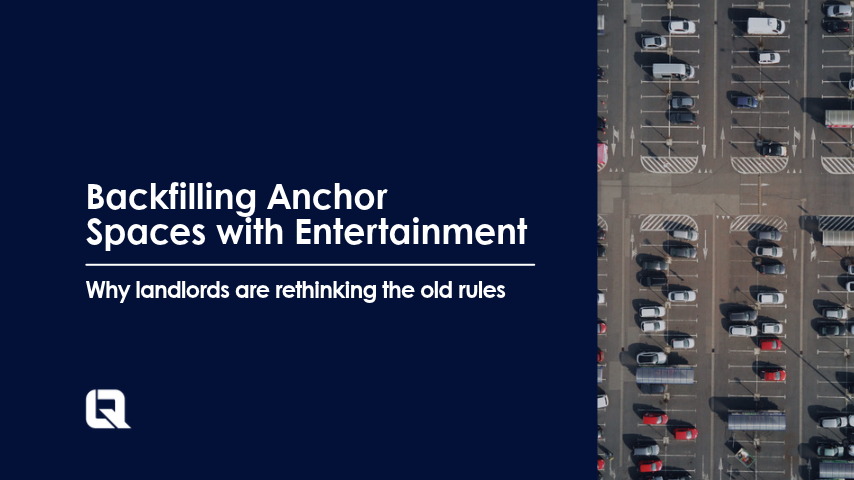
Backfilling Anchor Spaces with Entertainment: Why Landlords Are Rethinking the Old Rules
For years, “entertainment” has been a red flag word in shopping center leasing. Many landlords steer away from these tenants outright, and co-tenants often write restrictions into their own leases limiting entertainment uses on the property. The concern is usually the same: entertainment draws crowds without driving proportional traffic to the rest of the center, and it eats up parking that other retailers depend on.
That conversation is starting to shift. At the 2026 ICSC@Florida show, location-based entertainment concepts (trampoline parks, escape rooms, arcade bars, and similar formats) came up repeatedly as a real answer to a growing problem: vacant anchor boxes that traditional big-box retailers no longer want to fill.
Where the hesitation comes from
The parking concern isn’t irrational. A large-format entertainment user can generate high foot traffic in concentrated bursts, particularly on evenings and weekends when the rest of the center is also busy. Co-tenancy language written a decade or two ago reflects that assumption, and it’s often applied uniformly regardless of the specific concept or its actual draw.
The problem is that this blanket caution is now colliding with a real leasing gap. Anchor-sized boxes are sitting vacant longer as traditional retail demand for that footprint shrinks, and entertainment tenants are some of the few users actively looking for that scale of space.
The data doesn’t support a blanket “no”
Family and social entertainment trips actually bring more people per vehicle than a typical shopping trip. The 2022 National Household Travel Survey (Table 5-2) tracks vehicle occupancy by trip purpose, measured as person-miles per vehicle-mile:
Average Vehicle Occupancy for Selected Trip Purposes
| Trip Purpose | |||||
| Category | To/From Work | Shopping | Other Family/ Personal Errands | Social and Recreational | All |
Average vehicle occupancy | 1.08 | 1.53 | 1.60 | 1.99 | 1.52 |
Source: (2022 NHTS, Table 5-2, person-miles per vehicle-mile)
In practical terms, an entertainment visit is more likely to arrive as a family or group in one car than a typical shopping trip is. Raw visitor counts can look alarming on paper, but the vehicle demand behind those visits is often lower than a same-size retail or restaurant use would generate. This is exactly the kind of concept-specific differences landlords should consider before defaulting to a rejection.
None of this means every entertainment concept is a fit. A large-format concept with late-night hours or a heavy alcohol component in a small, high-turnover center is a different risk profile than a family-oriented trampoline park anchoring a center with ample parking. The point isn’t that entertainment is always low-risk. It’s that the risk needs to be evaluated concept by concept instead of screened out by category.
The upside goes beyond parking
Entertainment tenants don’t just fill vacant square footage. They extend dwell time on the property, and that tends to translate into secondary spend at nearby restaurants, cafes, and retailers, particularly from parents waiting on kids during a trampoline park or arcade visit. This is part of a broader trend the industry has started calling “retailtainment”: experience-driven concepts that give shoppers a reason to visit in person that e-commerce can’t replicate.
What this means for landlords and brokers
Before saying no to an entertainment user, dig into the specifics. What are the projected hours and peak times? What’s the actual expected occupancy load versus the space’s parking ratio? Is the co-tenancy restriction a relic from an older lease that no longer reflects current market reality?
Landlords and brokers have tools to manage the risk without defaulting to exclusion: capped parking ratios, radius restrictions tailored to the specific use, percentage rent structures, and updated traffic studies specific to the concept in question. As anchor vacancies persist and traditional retailers pull back from large-format space, entertainment concepts are becoming a legitimate backfill strategy, not just a fallback option.
LQ Commercial Group is a full-service commercial real estate brokerage serving Florida, North Carolina, and Puerto Rico. Whether you’re leasing, buying, selling, or trying to make sense of a shifting market, our team brings local expertise and data-driven insight to every deal. Reach out to LQ Commercial Group to see how we can help.
LQ Commercial | Research | research@lqre.com | lqcre.com/research